Trimmer heads and accessories for all types of vegetation: lawns, brush, and shrubs
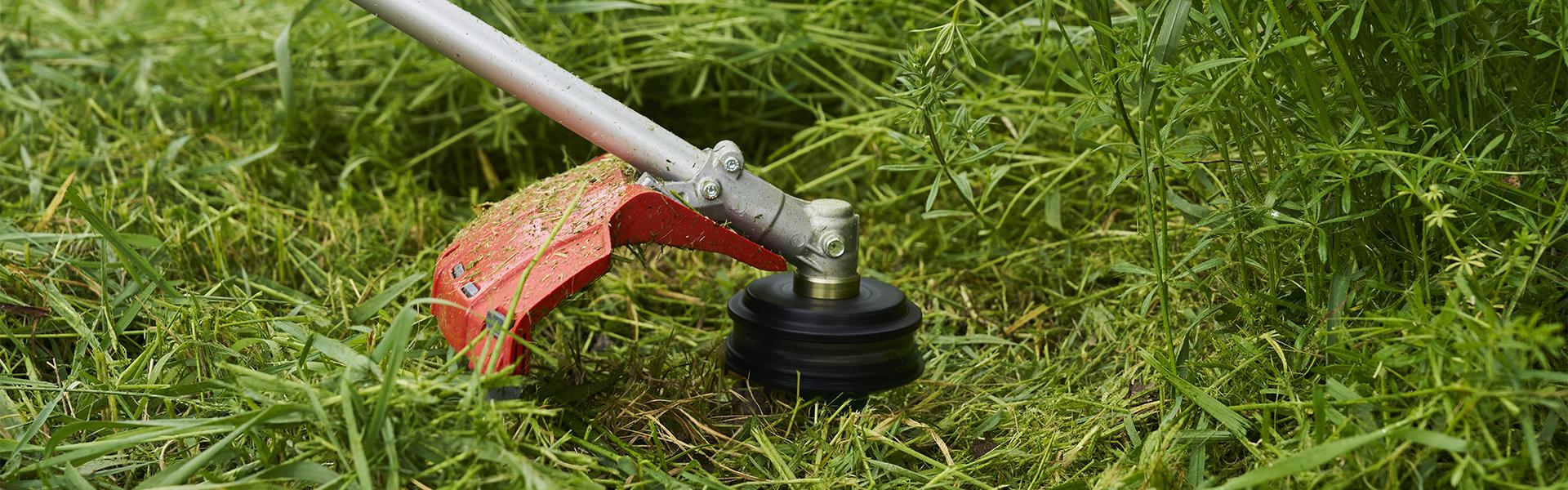
The versatility of the brushcutter is well known. It comes in handy for a wide range of tasks: you can use it to trim edges in the garden or tackle the most invasive brambles, for small, precise jobs or large-scale clearing, whether on flat ground or steep slopes. It’s also versatile in terms of the cutting implements you can use with it: trimmer heads, blades, discs, pruners (bar chainsaws, such as pruners), and hedgetrimmer blades. This article focuses on trimmer heads, blades, and discs for brushcutters: first, we’ll provide an overview, then we’ll look at what’s best to use for each specific application.
String trimmer heads
Our catalog offers various types of universal trimmer heads for your brushcutter. You can mount them on Efco brushcutters and, using adapters, on models from other brands:
-
Tap&Go and Tap&Go EVO, which are the most popular tap-and-go heads, available in various diameters ranging from 10.5 to 16 cm.
-
Load&Go, which are fast-charging tap-and-go heads, available in various diameters ranging from 10.3 to 13 cm.
-
4- or 8-line Multiline models with an aluminum body, available in 8- and 12-cm diameters.
With a tap-and-go head, you don’t have to stop working to reload the line when it runs out: while the brushcutter is running, simply tap the knob on the ground. With Load&Go heads, you can reload the line by winding it from the outside in just a few seconds, without having to open the plastic housing to wind it onto the inner spool (as is the case with classic “load-and-go” models). Multiline heads should not be loaded with continuous line but with sections of line that you purchase pre-cut or cut yourself.
Regardless of the type of trimmer head, the brushcutter line you use to refill it is crucial for cutting performance: choose it based on diameter, shape, and material depending on the vegetation you’ll be working on, from soft garden grass to thick underbrush. For the maximum line diameter that a brushcutter can accommodate, consult the user and maintenance manual. A good rule of thumb is to use the thickness of the line supplied with the brushcutter as a reference. The line’s thickness must be compatible with the brushcutter’s power output to ensure it isn’t overworked. The line affects the size of the trimmer head: the thicker the line, the larger the trimmer head’s diameter. Learn more about this topic in our guide to choosing the right line.
Blades and discs for brushcutters
The principle that the size, shape, and material of a cutting tool should be chosen based on the type of work also applies to brushcutter blades and discs. The Efco catalog offers several models, all made of special steel and heat-treated for greater durability:
-
Grass blades, 25.5 and 30.5 cm.
-
3-tooth discs with diameters of 23 and 25.5 cm.
-
3-tooth/point discs with diameters of 25.5 and 30.5 cm.
-
4-tooth discs with diameters of 20, 23, and 25.5 cm.
-
Circular/saw blades with 8 teeth, diameters of 23 and 25.5 cm.
-
Circular/saw blades with 22 teeth, diameter of 20 cm.
-
Circular/saw blades with 60 and 80 teeth, diameters of 23 and 25.5 cm.
-
3-tooth/point brush discs with diameters of 25.5 and 30.5 cm.
-
Curved 2-tooth shredder disc with diameter of 30.5 cm.
As a general rule, grass blades should only be used for trimming tall grass and weeds; discs are designed for cutting tall, dense grass, brush, reeds, saplings, and shrubs, while circular wood-cutting discs can also be used to cut down small trees (up to 5 cm in diameter for Efco models).
Not all brushcutters can be fitted with blades and/or discs: check your user manual to see if this is possible, and which blade or disc models should be used. Keep in mind that using the wrong type of blade or disc increases the risk of kickback (we’ll discuss this later). Just as for trimmer lines, the larger (and heavier) the blade or disc, the more powerful the brushcutter needs to be.


Maintaining your lawn
In a home garden, the lawn is usually made up of grass that has been specifically planted, primarily—though not exclusively—for aesthetic purposes. It requires care through fertilization, watering, and, of course, mowing. Mowing the lawn properly helps, among other things, to prevent diseases that affect the lawn.
To mow the grass in your garden, use a brushcutter equipped with a string trimmer head, which cuts and then shreds the grass. You can choose our Spiral string or the classic round-section Greenline. The trimmer head is also perfect for trimming edges—for example, after mowing—because the line is flexible, making it ideal for cutting close to borders, curbs, sidewalks, etc.
Mowing a large lawn
Do you live outside the city? Perhaps you have a very large yard, or maybe you need to mow that grassy area that serves as a “transition” between your yard and the surrounding countryside. For a wide-open lawn that needs frequent mowing, you can choose a string trimmer head—preferably one with square-section string, like our Greenline. Alternatively, you can use a grass blade. The string gives you a neater result because it shreds the grass, whereas the blade leaves it intact. The blade is therefore best if a clean finish isn’t a priority or if you plan to collect the clippings after mowing.
When there are low walls, fences, logs, etc., near the vegetation to be cut—in this case, grass—you should use the string instead of the blade to avoid kickback, choosing the type suitable for the vegetation. Kickback is a sudden sideways jolt you feel from the brushcutter when the metal blade or disc of the cutting mechanism strikes a hard or stationary object. Because it is flexible, the line is also suitable for trimming grass around trees or under hedges without damaging the trunk or base (collar).
Mowing the lawn to make hay
Do you have a large, uncultivated meadow in the countryside, or perhaps a field where you grow fruit trees and/or have placed beehives? It should be cut a few times a year, when the grass is tall, to make hay that you can use as mulch or, if you raise animals, as feed for them. In this case, do not use a brushcutter equipped with a string trimmer head—which chops the grass into small pieces—but rather a grass blade or a 3-point disc or saw-toothed blade, so that the grass remains whole, ready to be dried and then harvested.
Clearing an overgrown plot
Do you find yourself having to clear a field that hasn’t been mowed in a long time, where weeds, shrubs, and trees have taken over, or where brambles, plants, brush, and other dry vegetation have formed an impenetrable tangle? Clearing an overgrown plot of land may be a requirement for safety reasons—to prevent fire hazards—and for public health, to prevent the proliferation of insects, rats, and other pests. Alternatively, it may be necessary to make the land suitable for cultivation.
To clear an overgrown area, you can use a trimmer head loaded with line designed for tough vegetation such as weeds, brush, and undergrowth shrubs. For this purpose, our catalog features special, professional-grade lines—Titanium, Platin-Cut, and Saw-Blade Gold—which can also handle low walls, stones, stumps, and the like.
You can also use 3-point discs and saw blades, but be careful of the risk of kickback, especially where you can’t see clearly what you’re cutting. To prevent accidents and damage to the brushcutter, we recommend that you inspect the area before starting work to identify and, whenever possible, remove anything that could cause a kickback and/or be thrown by the moving cutting mechanism: rocks, pieces of metal or wood, and so on.


Clearing other thick-stemmed vegetation
If you need to cut grass, shrubs, small trees in the undergrowth, or reeds, the special lines we mentioned earlier are suitable, as are saw blades. The Efco Catalog also offers a 3-tooth brush disc.
To shred brambles, we recommend the curved tooth shredder disc. It is suitable for all situations, whether dealing with herbaceous brambles or dry brambles (woody ones with thicker stems, i.e., the toughest ones). With the shredder disc, you can also cut brush, shrubs, reeds, and undergrowth into small pieces. If the brambles are only herbaceous, you can use a head with a special round or serrated line with a diameter of 3-3.5 mm. Clearing brambles requires a specific cutting technique: we discussed this in our guide on how to clear brambles.
Safety and maintenance with a brushcutter
When using a brushcutter with a trimmer head—and especially when using blades or discs—wear protective clothing: in addition to a face shield and ear protection, wear protective footwear, pants or leg guards, a jacket, and cut-resistant gloves. If you use a blade or disc, the harness, which helps you support the brushcutter, must have a quick-release system.
In fact, blades and discs can be dangerous: they must be inspected and—if there are cracks or breaks—replaced. Not only that, but when necessary, they must be sharpened carefully or replaced if they have reached their limit of sharpness. For professional sharpening, contact your trusted Efco service center: a job not done properly increases the risk of kickback.
The bevel gear is a key component of the brushcutter: it drives the cutting implement you’ve installed (trimmer head, blade, or disc) by transferring the rotation from the drive shaft in the rod. When performing maintenance on your brushcutter, remember to lubricate the bevel gear and the rod with molybdenum disulfide grease according to the instructions in the user manual. Here you can learn more about lubricating your brushcutter and, more generally, about maintaining your brushcutter (gas-powered).
We’ll wrap up this article with an overview of what you can cut with a brushcutter and how to choose the best brushcutter for your needs.
Related articles

Petrol-engine or battery-powered blower: which should you choose?

How to clean a mistblower after use?

Power generators: all the possible uses