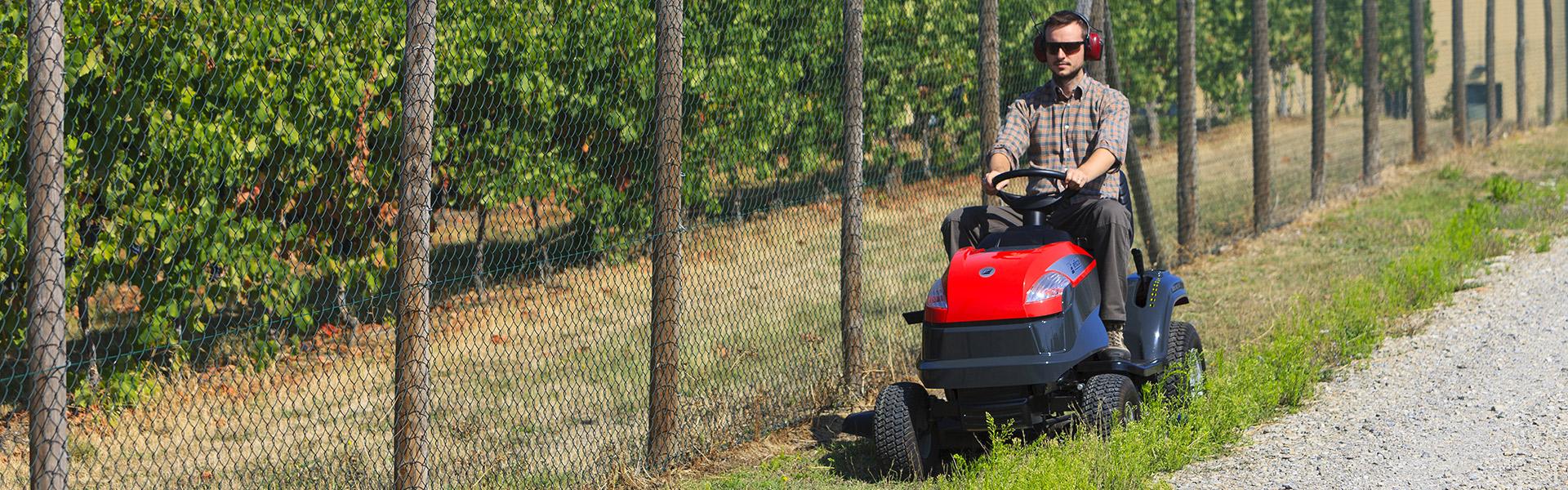
The ABCs of mowing

If you have a garden, you know full well that the lawn is somewhat the star of the show—if only because of the effort it requires. It’s an ongoing commitment from spring through fall, with a break between November/December and February when the grass stops growing—or turns yellow and goes dormant—only to come back to life in the spring.
In a garden, we tend to refer to it as a lawn rather than simply “turf”, created by sowing selected grass species and maintained through regular care, primarily for aesthetic purposes. Turf, in the strict sense, is productive: it provides forage, supports fruit trees, serves as pasture, and so on. Hereinafter, we’ll use both terms to refer to the lawn.
Today we’ll provide an overview of lawn mowing, the primary activity in garden lawn maintenance, along with watering and fertilizing. We’ll also look at how to revitalize it through aeration if it’s struggling.
How to adjust the grass cutting height
Mowing is probably the most common task in lawn care. It stimulates grass growth; when mowed frequently, the grass becomes thicker and produces new shoots. A thick lawn naturally suppresses weeds, which are a constant threat to the uniformity and health of your garden’s grass.
The ideal mowing height for your turf depends on the grass species it consists of, but as a general guideline, it should be around 4-5 cm. In any case, we recommend that you don’t cut more than one-third of the grass’s length at a time. If the grass has grown quite long, it’s best to gradually trim it down to the ideal height, rather than in a single cut.
From June through August/September, raise the mowing height by about one-third. This protects the base of the grass plants—the crown, which allows the grass to grow—and limits water loss from the soil due to evaporation. Meanwhile, reduce the frequency of mowing if you have a lawn of cool-season grasses, which slow their growth in the summer. If, on the other hand, your turf consists of warm-season grasses—which reach their peak growth during hot weather—maintain your usual mowing frequency. In the fall, too, the cutting height should be raised slightly compared to spring, to protect the crown from the winter cold and avoid compromising photosynthesis during the time of year when the grass, like all plants, has less light available.


How to mow the lawn in your garden
In the garden, you can manage mowing by collecting the clippings or mulching. In the first case, you’ll need a grass trimmer or a rear-discharge or ride-on garden tractor equipped with a grass catcher. Alternatively, you’ll need to collect the clippings by hand, using a rake. In the second case, the grass trimmer or garden tractor must be set up for mulching, which chops the grass into very fine pieces and leaves it in place, where it decomposes quickly and fertilizes the soil.
Which should you choose: grass trimmer or garden tractor? It depends largely on the size of the lawn. The Efco catalog offers numerous models of push grass trimmers and self-propelled grass trimmers, which can mow up to 1,600 and 2,600 sqm, respectively. For garden tractors, we offer ride-on garden tractors for lawns up to 4,000 sqm, rear-discharge garden tractors (up to 9,000 sqm), and zero-turn garden tractors. Unlike other garden tractors, these models do not have a collection system but use the mulching technique; they are controlled by levers, rotate 360° on the spot to simplify maneuvering, and can mow up to 14,000 sqm.
With a robot mower, you enjoy the convenience of automating lawn mowing. It works by making frequent, shallow cuts: in practice, you get the same effect as mulching with a grass trimmer or garden tractor. It automatically avoids obstacles (trees, flower beds, etc.) and manages its own power by returning to the charging station when needed. The result is a uniform and well-manicured lawn.
When choosing a robot mower, the key factor to consider is the size of your yard: we offer models for lawns up to 2,000 sqm. On this topic, you’ll find a comparison here between robot mowers, garden tractors, and lawnmowers.
Trimming edges in the garden
Whether you’re using a grass trimmer or a garden tractor, you can adjust the cutting height to your liking to achieve an even lawn—provided you make precise passes with the mower and keep the blades well-sharpened. To trim the grass in your garden, you can also use a brushcutter equipped with a string trimmer head, which chops up the grass, though the cut is generally less precise.
On the other hand, the brushcutter is unbeatable if you have a garden that isn’t perfectly flat—one that might have some bumps. It’s also unbeatable in difficult spots: narrow, hard-to-reach areas, steep slopes, etc. After mowing with a lawnmower or garden tractor, it’s ideal both for trimming edges along low walls, sidewalks, flower beds, etc., without the risk of kickback, and for cutting grass around trees or under hedges without damaging the trunk. By the way, here’s our article on how to trim lawn edges.


Revitalizing the lawn
Collecting clippings with the grass catcher on your lawnmower or garden tractor isn’t just a matter of aesthetics. It also helps prevent thatch formation, that is, the layer of plant material (roots, leaves, clippings, etc.) that accumulates when the soil can no longer break it down. Thatch blocks out light, oxygen, and water, as well as fertilizers and seeds, ultimately weakening the lawn.
To prevent thatch buildup, mulching should always be done when the turf is dry and while temperatures allow the chopped grass to decompose properly. Therefore, in the fall, you should stop mulching and collect the clippings. Otherwise, the turf will be more susceptible to fungal diseases, as well as thatch buildup.
Scarifying (or aeration) is the process of breaking up and lifting thatch, which must then be collected and disposed of. It is done using a scarifier, whose blades also make shallow cuts in the soil, helping to loosen it. Aeration also removes moss, which often forms among the grass in damp and shaded areas of the garden. If you’re overseeding to thicken thinning turf, aeration is one of the preparatory steps: see how to reseed a damaged lawn.
To prevent thatch, we also recommend keeping your yard clean, especially when leaves fall in the fall, when you’re pruning, or when doing other yard work. To clear your turf of dry leaves, pruning debris, and so on, you can use a rake or a leaf blower.
How to cut the tall grass in a meadow
A meadow is understood as an open field where grass grows but isn’t maintained like a garden lawn. If you find yourself cutting tall, tough weeds, brush, etc., this is no longer a matter of routine maintenance like that required for a lawn. Rather, it involves the periodic clearing of land for safety or health reasons, to make hay, to manage cover cropping in a vineyard or orchard, etc.
In these cases, it’s not worth collecting and disposing of the clippings or using a mulching mower, and you have several equipment options to choose from. You can take advantage of the brushcutter’s versatility by attaching a grass blade, a multi-tooth disc, or a saw blade if you want to make hay. If, on the other hand, the goal is simply to clear the area, both discs and a string trimmer head loaded with special highly durable string will work well. Here you’ll find an overview of the use of trimmer heads, blades, and discs for brushcutters.
If the area is quite large—2,000 sqm or more—we recommend a side-discharge garden tractor, which expels the clippings on the spot: Efco models can handle meadows up to 8,000 sqm. Alternatively, you can go for a rear-discharge garden tractor without a grass catcher.
Another option is a wheeled brushcutter: we offer models with reinforced mulching blades that can process up to 5,000 sqm of tall grass and weeds, leaving the clippings on the ground. In addition to tall grass and weeds, a wheeled brushcutter can handle other tough vegetation up to 1.5 cm thick. The grass shredder family also includes flail mowers designed for even thicker vegetation: learn more here about the differences between wheeled brushcutters and flail mowers.
Finally, what should you wear to work safely while mowing the lawn? Protective clothing is a must: wear safety shoes, work pants, and work gloves, as well as ear protection, safety goggles or a face shield (the latter are not necessary when using a garden tractor). If you’re using a brushcutter with a blade or disc instead of a string trimmer, your footwear, pants, jacket, and gloves must be cut-resistant.
Related articles


A real Christmas tree? Here's how to keep it in the home
Everything a high-pressure washer can do